
Refunds are one of the quieter sources of Google Analytics/WooCommerce data mismatch, precisely because they don’t cause an obvious, immediate discrepancy — they cause a slow, compounding one that only becomes visible months later when someone finally notices GA4’s revenue figures have been running persistently higher than what actually landed in the business. This guide covers why that happens and how to fix it properly.
The Default Behavior: GA4 Doesn’t Know About Refunds Unless You Tell It
When a purchase event fires in Google Analytics, it’s a point-in-time record — a snapshot of the order at the moment it was completed, capturing value, currency, items, and transaction ID as they stood at that instant. GA4 has no native mechanism for automatically monitoring your WooCommerce orders for later status changes and adjusting that original event retroactively. If a customer later receives a full or partial refund, WooCommerce’s own order records reflect that change immediately — but GA4’s original purchase event remains exactly as it was recorded, unless you specifically configure a separate refund event to fire when the refund is processed.
This means that, by default, any store processing a meaningful volume of refunds will see its GA4 revenue figures run persistently higher than actual realized revenue — and the gap compounds over time as more refunds accumulate across more historical purchase events that were never adjusted.
Setting Up Refund Event Tracking
GA4 has a native refund event type built specifically for this purpose, structured similarly to purchase but representing a reversal rather than a completion.
What the event needs to carry:
transaction_id— critically, this must match the transaction ID of the original purchase event, since this is how GA4 connects a refund back to the specific order it’s reversing.value— the refunded amount, which may be the full order value (full refund) or a partial amount (partial refund).currency— matching your property’s configured currency.- Optionally, an
itemsarray if you want product-level refund detail rather than just an order-level adjustment.
Where this needs to hook into WooCommerce: your tracking implementation needs to listen for WooCommerce’s refund-related actions (WooCommerce fires specific hooks when an order is refunded, whether processed manually by a store admin or automatically through a payment gateway’s refund API) and fire the corresponding GA4 refund event at that moment, formatted with the correct transaction ID and value.
This is a genuinely easy piece of tracking to overlook, since it doesn’t affect whether your day-to-day purchase tracking looks like it’s “working” — a store can have flawless purchase event tracking and still be silently overstating revenue indefinitely if refund events were never configured at all.
How TrueAna helps
How TrueAna and Measurement Protocol Improve Refund Tracking
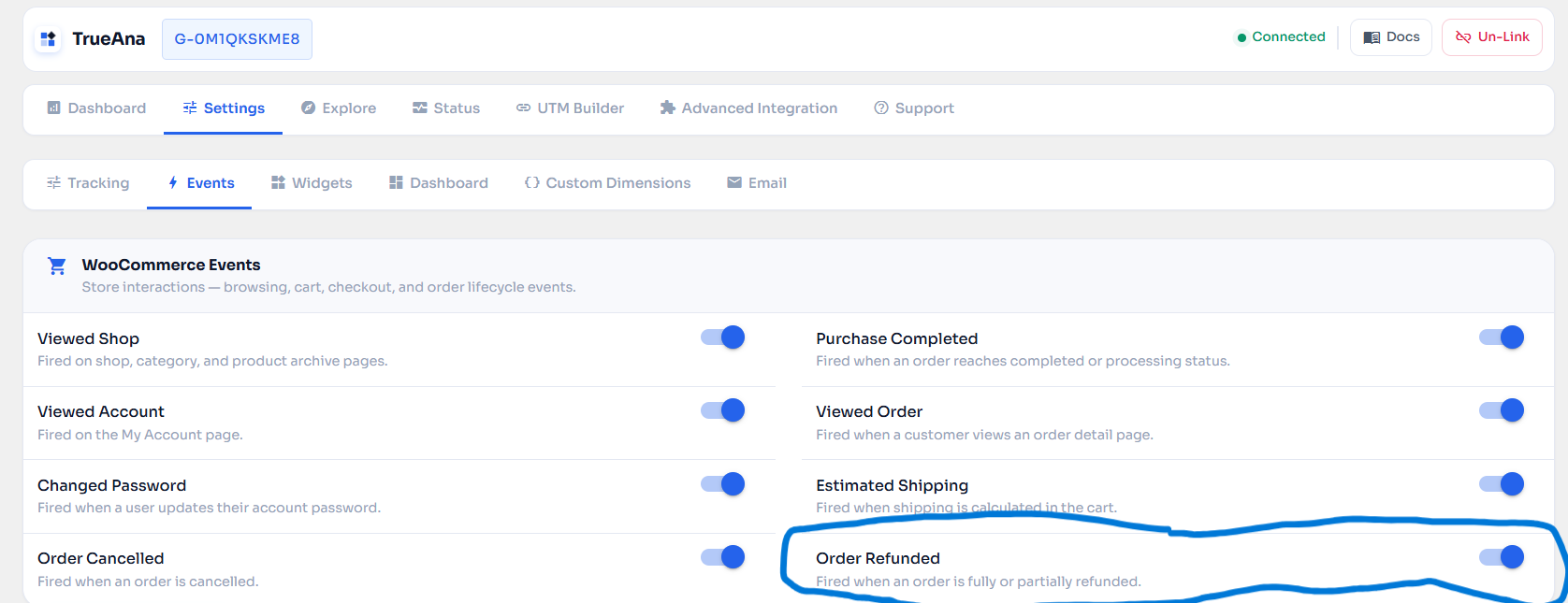
Refund tracking has the same structural weakness as purchase tracking: if it’s implemented client-side only, it depends on an admin’s browser session being open and gtag.js actually loading at the moment a refund is processed. In practice, refunds are frequently issued from wp-admin during routine order management, through automated payment-gateway webhooks, or via bulk order updates — none of which reliably involve a browser session that fires client-side JavaScript at all. That’s a second, quieter version of the same gap covered in tracking loss elsewhere on this site.
TrueAna hooks directly into WooCommerce’s native refund actions — whether a refund is triggered manually by an admin, automatically through a payment gateway’s refund API, or via a bulk status change — and sends the corresponding GA4 refund event through the Measurement Protocol from the server itself. Because the event is generated by the order-status change directly rather than by a browser needing to be present and running JavaScript at that moment, it fires consistently regardless of how or where the refund was actually processed.
Specifically, this closes a few gaps that client-side-only refund tracking leaves open:
- Refunds processed automatically by a payment gateway (with no admin browser session involved at all) still generate a matching
refundevent. - The
transaction_idis pulled directly from the WooCommerce order record, so it reliably matches the original purchase event instead of relying on manually re-entering or looking up the correct ID. - Partial refunds are captured with the correct partial
value, taken directly from the amount WooCommerce recorded as refunded on that order. - Because this runs through the same Measurement Protocol pathway used for purchase events, refund data isn’t dependent on the customer’s (or admin’s) browser or blocking software at all — it’s a server-to-server transmission from the start.
The result is that GA4’s net revenue figures stay closer to what WooCommerce and your payment processor actually show, without needing a store owner to manually audit refunds against GA4 events or rebuild this hook-to-event mapping themselves.
Verifying Refund Tracking Works Correctly
Process a test refund (using your payment gateway’s test/sandbox mode against a test order, if available) and check DebugView for the resulting refund event, confirming the transaction ID matches the original purchase and the value reflects the correct refunded amount. If nothing appears in DebugView after processing a refund, that’s a clear sign refund tracking either isn’t configured at all, or isn’t correctly hooked into WooCommerce’s refund process.
Reading Refund Data in GA4’s Reports
Once configured, refund data affects your reports in a specific way: GA4’s revenue metrics (Total revenue, Purchase revenue) are generally calculated net of any recorded refunds, giving you a more accurate, realized-revenue figure rather than gross order value at time of purchase. You can also view refund activity specifically — Admin → Events will show refund event counts, and a Free Form Exploration using refund as the event filter can show refund value broken down by product, time period, or any other relevant dimension, useful for identifying whether a specific product has an unusually high refund rate worth investigating.
Using Refund Data to Identify Product or Fulfillment Problems
Beyond just correcting revenue totals, refund tracking — once properly configured — becomes a genuinely useful diagnostic signal in its own right. A product with a refund rate meaningfully higher than your store average is worth investigating specifically: is the product description setting inaccurate expectations, is there a sizing or fit issue (common for apparel), is there a quality control problem with a specific supplier or batch, or is the product simply being marketed to an audience it doesn’t actually serve well?
Building a Free Form Exploration with rows as Item name, values as Item revenue and Refund value (once available as a metric from your configured refund events), lets you calculate an effective refund rate per product — a specific, actionable metric that a store owner without this tracking configured would have no systematic way to monitor beyond manually reviewing individual refund requests as they come in.
A Practical Recommendation: Don’t Try to Solve This Retroactively
Refund event tracking, once configured, only affects data going forward from implementation — it won’t retroactively adjust historical purchase events that predate the refund tracking setup. This means if you’re implementing refund tracking for the first time on a store with significant order history, your historical GA4 revenue figures for periods before implementation will remain overstated relative to actual realized revenue, and there’s no practical way to correct this after the fact within GA4 itself. The practical takeaway: implement refund tracking as early as possible in your store’s tracking setup, rather than treating it as an optional add-on to address later, since the cost of delay compounds with every refund processed in the meantime.
When WooCommerce’s Own Reports Are the Better Source
For any situation where precise, complete refund accounting genuinely matters — actual financial reporting, tax preparation, reconciling with your payment processor — WooCommerce’s own order and refund records remain the authoritative source, not GA4. GA4’s refund tracking, even correctly configured, is valuable for behavioral and marketing-analysis purposes (understanding refund patterns by product, channel, or campaign) rather than as a replacement for your actual bookkeeping and financial records, which should always trace back to WooCommerce’s own order data and your payment processor’s records directly.
A Worked Example of the Compounding Effect
Consider a store processing 400 orders a month at an average order value of $60, generating roughly $24,000 in gross monthly revenue as recorded by GA4’s purchase events. If that store has a 5% refund rate — a plausible, unremarkable figure for many product categories — that’s 20 refunded orders a month, at an average refund value close to the average order value, representing roughly $1,200 in revenue GA4 continues to report as realized despite it never actually staying with the business.
Over twelve months, without refund tracking configured, that’s approximately $14,400 in phantom revenue accumulated in GA4’s historical reporting — a gap large enough to meaningfully distort year-over-year trend analysis, ROAS calculations for campaigns run during that period, and any decision that relied on GA4’s revenue figures as a source of truth rather than cross-checking against WooCommerce’s own records. This is exactly the kind of slow, compounding discrepancy that refund tracking is designed to prevent from accumulating in the first place.
Frequently Asked Questions
Does GA4 support partial refunds specifically, not just full order refunds?
Yes — the refund event’s value parameter can reflect a partial amount, and if you’re capturing item-level detail, a partial refund on specific items within a multi-item order can be represented through a corresponding partial items array, though this requires more careful implementation than a simple full-order refund.
What happens if a refund event fires with a transaction ID that doesn’t match any existing purchase event?
GA4 generally won’t be able to properly connect and net the refund against a purchase it can’t match, which can result in the refund not correctly adjusting your revenue figures — this is why exact transaction ID matching between the original purchase and any later refund event is critical to get right.
How do I handle refunds for orders that were placed before I set up ecommerce tracking at all?
There’s no way to retroactively create the original purchase event for tracking purposes, so a refund on a pre-tracking-setup order has nothing to net against in GA4 — this is simply an inherent limitation of implementing tracking after a store has already been operating for some time, rather than something fixable after the fact.
Should small stores with very few refunds bother setting this up?
Even a small number of refunds compounds over time, and the setup effort (for a plugin handling this natively) is generally low relative to the ongoing accuracy benefit — there’s little downside to configuring refund tracking even for a store with currently low refund volume, since it protects against future accumulation as order volume grows.
Does a full order cancellation before fulfillment count as a refund for GA4 tracking purposes?
It depends on how WooCommerce itself categorizes the cancellation — if it’s processed through WooCommerce’s refund mechanism (even for an order that never shipped), the same refund event tracking approach applies. If it’s handled as a separate order status change without a formal refund transaction, it may require its own distinct tracking consideration, worth checking against how your specific payment gateway and WooCommerce configuration actually process cancellations.
Does TrueAna’s refund tracking work even if a refund is issued automatically by a payment gateway, with no admin logged into wp-admin?
Yes — because TrueAna hooks into WooCommerce’s order-status change directly and sends the refund event server-side through the Measurement Protocol, it doesn’t depend on an admin browser session being open at the moment the refund happens. A gateway-initiated automatic refund is captured the same way as a manually processed one.